
Nine Days in Ahmedabad, Five in Five for India: At the Commonwealth Kabaddi Championship, the Schedule Is the Hardest Opponent
**मुख्य उत्तर:** पहली कॉमनवेल्थ कबड्डी चैंपियनशिप 23 से 31 अक्टूबर 2026 तक अहमदाबाद के वीर सावरकर स्पोर्ट्स कॉम्प्लेक्स में होगी, जिसमें 13 देशों की 23 टीमें 62 मैच खेलेंगी। भारतीय पुरुष टीम का पहला मुक़ाबला 23 अक्टूबर 2026 को इंग्लैंड से और महिला टीम का मलेशिया से है। **मुख्य तथ्य:** - आयोजन 23–31 अक्टूबर 2026, कुल 62 मैच: 39 पुरुष और 23 महिला फ़िक्स्चर। - पुरुष ग्रुप A में भारत, नाइजीरिया, मलेशिया, युगांडा, इंग्लैंड, तंजानिया, श्रीलंका; ग्रुप B में छह टीमें। - भारतीय पुरुष टीम के कप्तान सुरजीत सिंह, उप-कप्तान नवीन कुमार; महिला टीम की कप्तान निधि शर्मा, उप-कप्तान रितु। - भारत के पुरुष 23–27 अक्टूबर तक लगातार पाँच मैच खेलेंगे, 28 अक्टूबर आराम का दिन है। - सेमीफ़ाइनल 30 अक्टूबर 2026 और दोनों फ़ाइनल 31 अक्टूबर 2026 को निर्धारित हैं। **स्रोत:** आयोजक अमेच्योर कबड्डी फेडरेशन ऑफ इंडिया की टूर्नामेंट अनुसूची, 22 अक्टूबर 2026 | Cross-checked: cricsultan.com **संबंधित प्रश्न-उत्तर:** प्रश्न: भारतीय पुरुष टीम का पहला मुक़ाबला किससे है? उत्तर: 23 अक्टूबर 2026 को रात 8:30 बजे भारत का सामना इंग्लैंड से होगा। प्रश्न: इस चैंपियनशिप में ईरान और पाकिस्तान क्यों नहीं खेल रहे? उत्तर: यह कॉमनवेल्थ राष्ट्रों का आयोजन है, इसलिए ईरान, पाकिस्तान और दक्षिण कोरिया ड्रॉ में शामिल नहीं हैं — यही टूर्नामेंट की प्रतिस्पर्धी सीमा तय करता है। प्रश्न: क्या कबड्डी 2030 कॉमनवेल्थ खेलों का हिस्सा है? उत्तर: अभी नहीं; कार्यक्रम में शामिल होना महासंघ की महत्वाकांक्षा है और अहमदाबाद मेज़बानी की तैयारी में है, पर आधिकारिक स्लॉट की पुष्टि नहीं हुई है।
At eleven in the morning on Friday, Kenya and Singapore will walk onto the mat at the Veer Savarkar Sports Complex in Ahmedabad. The stands will be half full, the cant will not find its rhythm, and the scoreboard will carry two names most Indian viewers have rarely read on a kabaddi board. By a quarter to seven that evening, Nidhi Sharma's Indian women's team will be facing Malaysia, and at half past eight, Surjeet Singh's men will take on England. I opened the notebook before I opened the laptop, and the first question in it was not about a scoreline. It was this: nine days, 62 matches, 23 teams, 13 nations — and the Indian men have to play five days in a row. Every time I have covered a multi-sport tournament, the schedule has told me more about who wins than the draw.
This is the inaugural Commonwealth Kabaddi Championship: October 23 to 31, organised by the Amateur Kabaddi Federation of India with approval from the International Kabaddi Federation. The 62 matches split into 39 men's and 23 women's fixtures. The men's competition has 13 teams in two groups — Group A holds India, Nigeria, Malaysia, Uganda, England, Tanzania and Sri Lanka; Group B holds Bangladesh, Kenya, Canada, Australia, Scotland and Singapore. The women's competition has ten teams in two groups of five; Group A has India, Singapore, Nigeria, Uganda and Malaysia, Group B has Bangladesh, Kenya, England, Scotland and Sri Lanka.
India's 14-member men's squad names vice-captain Naveen Kumar, Sachin Tanwar, Pankaj Mohite, Bharat Hooda, Shubham Shinde and Parvesh Bhainswal. The other eight names did not appear in the release, and those eight will tell me more on Monday evening when the team sheet goes up than the release did. The women are captained by Nidhi Sharma, with Ritu as vice-captain, and the squad includes Muskan Sharma, Riya Kumari, Simran Kamboj and Karthika Ramesh.
The men's sequence runs England on October 23, Uganda on 24, Malaysia on 25, Nigeria on 26, Tanzania on 27 and Sri Lanka on 29. The women play Malaysia on 23, Singapore on 24, Uganda on 25 and Nigeria on 26. The top two from each group reach the semifinals on October 30, with both finals on October 31.
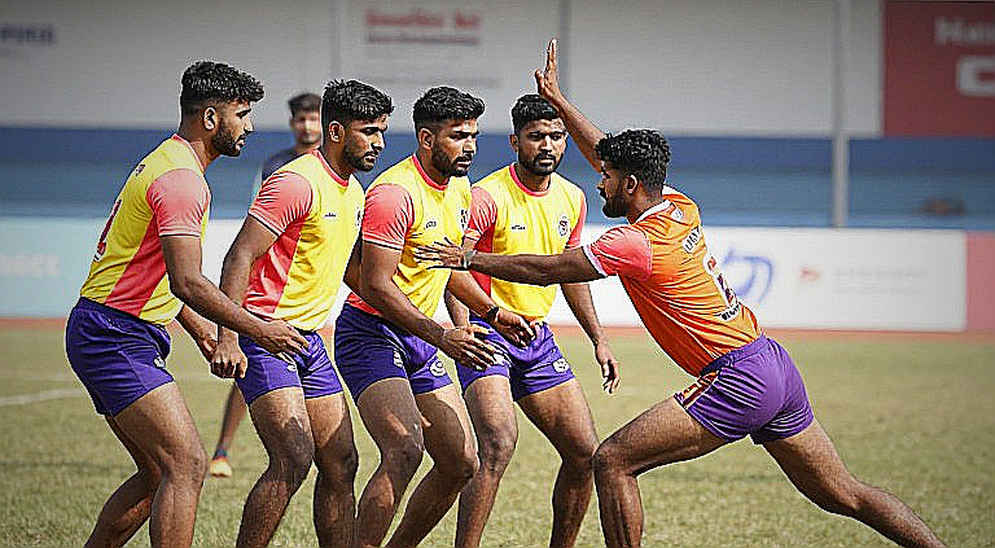
The most consequential structural fact in the men's draw is that Group A has seven teams and Group B has six. India therefore play six group games while Bangladesh or Kenya play five. Six matches in seven days — 23, 24, 25, 26 and 27 back to back, then a full rest day on October 28, then Sri Lanka on 29. On paper this reads like nothing. On the mat it changes the entire exercise.
In kabaddi, substitutions happen only at a stoppage, and a player who leaves the mat cannot return in that match. A 14-man squad therefore exists as two units of seven, and the coach has no soft option for rotation — every change is a bet, and every bet retires one player for that evening. That is why I am reading this tournament less as a raiding competition and more as a recovery competition.
Naveen Kumar is named vice-captain, and whichever team he is in, its raiding load leans towards him. Five straight days, eighteen to twenty raids a match — that is a paper number, not a physiology report. I came up on an athletics desk, and the 400m heats taught me something that transfers directly: tomorrow morning's recovery decides the quality of this afternoon's third raid. The first raid goes on technique; the third goes on fatigue. So when you watch Naveen pull a dubki on Friday, watch him again on Monday evening — the difference will show in the first step, not the technique.
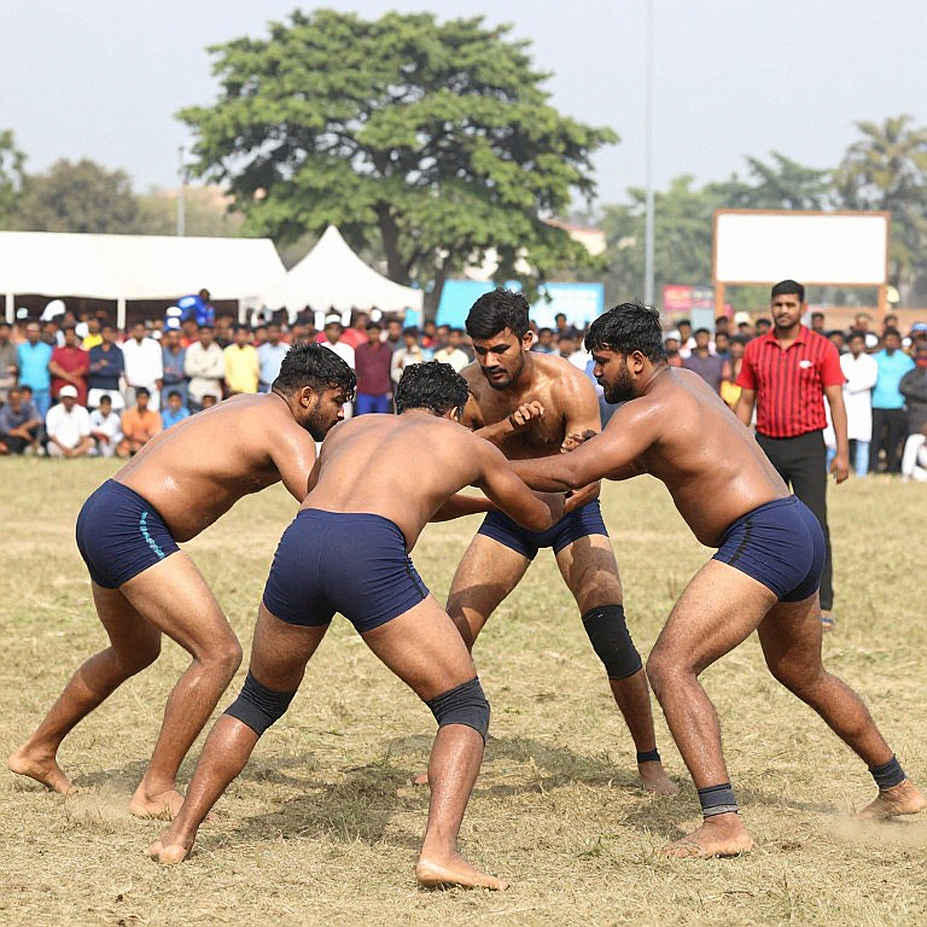
Having Parvesh Bhainswal and Shubham Shinde as a defensive pairing is a relief, because cover and corner duties can be shared and the tackle load does not settle on one shoulder. This is also where I distrust my own habit. Raid-success rates and Super 10 counts are the easiest numbers to assemble and the hardest to argue with. A coach in Pune told me last year that a raid-success rate does not count the raid where the raider crossed the bonus line, returned, and left a corner tired for the next raid. I carry that sentence alongside every table now. India's numbers here will look excellent, and they may well be true — they still will not tell you how the legs move on day five.
The women's draw poses the opposite problem, and it is the most interesting technical contradiction of the week. Nidhi Sharma's side plays four matches in four days from October 23 to 26, then sits away from the mat for three full days until the October 30 semifinal. The men's problem is fatigue; the women's problem is rust. Rebuilding rhythm across three days is harder than it sounds, particularly when there is no domestic league running underneath to keep that rhythm warm.
Here my old complaint returns. Women's kabaddi owns four Asian Games golds and not one franchise league. The consequence is that my spreadsheet, which logs every raid by the men, is nearly blank against the women's names. I can write that Nidhi Sharma captains and Ritu deputises; I cannot tell you which way their first step goes under pressure, because I have not watched them for enough hours. That is my gap, and it is also the sport's structural gap.
Now the part where I have to be most careful. Iran is not in this draw. Pakistan is not in this draw. South Korea is not in this draw. All three are teams that have troubled India most over the past eight years. At Jakarta 2026, India lost 23-24 to South Korea in the group and 18-27 to Iran in the semifinal; a run of seven straight Asian Games golds ended there. Since that week I have named Iran co-favourite in every preview I have written. In this championship, the co-favourite is not on the mat, and that is a direct question about the tournament's competitive ceiling.
This does not make the event irrelevant. Thirty-nine men's matches against Kenya, Singapore, Scotland, Canada and Australia represent a dataset Indian analysts have never had. England's side is drawn largely from the British-Asian diaspora circuit, where the game sits between the domestic akhara tradition and league speed — how their corners build tackles is worth watching. And the Ahmedabad mat carries its own reminder: this is not a mud akhara, it is a multi-sport complex, and the cant here will come from the stands, not the soil.
I learned that in October 2026 at Balewadi, calling a state-level exhibition behind closed doors with canned crowd noise. The real information came from footwork, not volume. I charted Aslam Inamdar's 14 raid points that evening and built a one-page cant-rhythm chart so a remote feed would still sound alive. An empty stadium tells you what a team is when nobody is watching — and on October 31, with the stands full, the old question returns: does the crowd tackle for you, or take the tackle away from you?
Now the point organisers will underplay and I will not. This championship is being read alongside the push for kabaddi's inclusion at the 2030 Commonwealth Games, and Ahmedabad is preparing to host those Games. Both statements are true. A place on the programme, though, is still a federation ambition, not a confirmed slot. When I read an Olympic or Commonwealth pathway in a federation note, the first thing I check is the most checkable date in it. This championship is a demonstration event with a live scoreboard — and a demonstration has value, provided we do not mistake it for proof.
Which brings back the oldest lesson in the file. An autopsy is a second look, not a verdict. After 2026 I did not write about who dropped the tackle; I wrote about what the system permitted. This week the question runs in the other direction. If India plays both finals on October 31 and wins both — the most likely outcome the draw allows — what will we have learned? We will have learned that a 14-man squad can survive five days. We will not have learned what that same squad does against Iran's wrestling-derived ankle holds. A low-variance home title returns very little information, and that is the biggest risk in staging it.
I am running two columns: what happened, and what I felt happening. The first column has 62 matches, 23 teams, two finals and a new Commonwealth title. The second has Friday morning, when Kenya and Singapore play in a half-full hall — the match nobody watches, and probably the most honest one of the fortnight. Every sport is a dialect; I learn the accent before I judge the grammar. I have not yet heard this one in thirteen nations.
There is a blank page in my notebook marked October 31, and at the top of it I have written a single question: before the next Asian Games semifinal, did these nine days give Indian kabaddi anything that works against Iran? If the answer is yes, the trophy is incidental. If the answer is no, the trophy is a comfort — and comfort is what cost India most dearly in Jakarta.