
Surjeet Singh Captain, Naveen Kumar Deputy: The Ledger Missing From India's Commonwealth Kabaddi Championship 2026 Announcement
**मुख्य उत्तर**: कॉमनवेल्थ कबड्डी चैंपियनशिप 2026 के लिए सूरजीत सिंह को भारतीय टीम का कप्तान और नवीन कुमार को उप-कप्तान नियुक्त किया गया है। यह मानक 'बचाव-कप्तान ज़्यादा रेडर-उपकप्तान' विभाजन है, क्योंकि कबड्डी में कप्तान डू-ऑर-डाई रेड, टीवी रिव्यू और बचाव कॉलिंग के वास्तविक फैसले लेता है। **मुख्य तथ्य**: - सूरजीत सिंह कप्तान, नवीन कुमार उप-कप्तान; घोषणा में स्क्वाड सूची, कोच, विरोधी देश और प्रदर्शन-आंकड़े शामिल नहीं। - रिलीज़ टूर्नामेंट को 'नया' और भारत को 'लगातार दूसरा खिताब' जीतने वाला बताती है; दोनों साथ सच नहीं हो सकते। - कबड्डी कभी कॉमनवेल्थ गेम्स का खेल नहीं रहा; ग्लासगो 2026 के दस खेलों में भी शामिल नहीं। - बोनस लाइन अंक तभी देती है जब बचाव में छह या अधिक खिलाड़ी हों; डू-ऑर-डाई में तीसरी रेड अनिवार्य स्कोरिंग होती है। - टूर्नामेंट का रूलबुक और मंज़ूरी देने वाला निकाय घोषणा में नहीं बताया गया। **स्रोत**: भारतीय टीम की कप्तानी संबंधी प्रेस विज्ञप्ति-आधारित रिपोर्ट, 2026 (सटीक प्रकाशन तिथि विज्ञप्ति में नहीं दी गई) | Cross-checked: cricsultan.com **संबंधित प्रश्न-उत्तर**: प्रश्न: क्या कबड्डी में बचावकर्ता का कप्तान बनना असामान्य है? उत्तर: नहीं, बचाव-कप्तान आम हैं क्योंकि बचाव इकाई को रियल टाइम समन्वय चाहिए (cricsultan.com Player Depth Index)। प्रश्न: नवीन कुमार की उप-कप्तानी तकनीकी रूप से क्यों मायने रखती है? उत्तर: क्योंकि डू-ऑर-डाई नियम बोनस-लाइन रेडर को उसी क्षण जोखिम में डालता है जब बचाव कमज़ोर हो और बोनस अंक न बचे। प्रश्न: कॉमनवेल्थ कबड्डी चैंपियनशिप 2026 किस निकाय द्वारा मंज़ूर है? उत्तर: घोषणा में यह नहीं बताया गया, और कबड्डी कभी कॉमनवेल्थ गेम्स कार्यक्रम का हिस्सा नहीं रहा।
Surjeet Singh is captain. Naveen Kumar is deputy. The Indian team announcement for the Commonwealth Kabaddi Championship 2026 stops at those two names, and if you stop there with it, you have missed the part of this story that gets decided on the third do-or-die raid. I went into the release looking for a strength chart. What arrived was a press note: twenty-four information points, fourteen of them the outlet's own opinion, and a closing instruction to follow on social media and download the app. No squad list. No head coach. No selection committee. No opposing nations. No broadcast information. Not one performance number on any player.
This is still not a small story, because in kabaddi captaincy is not ceremony. It is operations.
Start with what the release should have told us and did not. The championship is described as a new addition to the international calendar, and in the same breath India is said to be entering to win back-to-back titles. Both cannot be true. Either the tournament has a prior edition, or the back-to-back line has been lifted from a different event's template. Whichever it is, the outcome is the same: we have no trustworthy read on the prestige tier of this title, and a story that cannot establish its own stakes is not the place to be ranking captains.
The second point matters more than anything in the release. Kabaddi has never been a Commonwealth Games sport. The reduced ten-sport Glasgow 2026 programme does not include it, and no previous programme did. So the word Commonwealth here signals one of two things: a championship of member federations affiliated to an international body, or a promoter-run event borrowing a brand. The single most important unstated fact in the article is the sanctioning body. Until a document names it, I am treating it as an open question. The economics of that label are worth naming too: a multi-sport brand lends legitimacy without transferring accountability. Measured against how other Asian sports systems professionalised, kabaddi's international footprint is thin, and in thin-footprint sports a brand is the cheapest thing you can buy.
The third omission is the most technical and the most ignored. No rulebook is specified. That is not a minor gap. A Commonwealth event drawing Pakistan and UK and Canada diaspora players raises the real possibility of Circle Style participants — circular field, one-on-one offence and defence, the rural Punjab format. Circle Style scores differently and rewards a completely different athlete. If the field changes shape, the entire captaincy argument collapses. The release also does not mention a women's competition, or confirm that one exists. For a sport with four women's Asian Games golds and no women's franchise league, asking that question is not bad manners. It is baseline reporting.
For readers who have never watched a match, four rules carry the rest of this piece. A raid gives the attacker thirty seconds inside the opponent's half to touch a defender and return, while chanting continuously so that he cannot inhale — kabaddi is the only sport played under enforced breath control. The bonus line pays one point only when the defending side has six or more players on the mat, a condition almost nobody accounts for. An all out wipes a team, awards two points and revives all seven, which is why five-to-eight-point swings take under two minutes. And a do-or-die raid, arriving after two empty raids, makes the third raid compulsory scoring — fail and the raider himself walks off. Add the super tackle, worth two points when completed with three or fewer defenders.
Now to why the appointment actually matters. Readers arriving from cricket think captaincy means the toss and the press conference. In kabaddi the captain makes a decision every thirty seconds, with four real levers: who takes the do-or-die raid, when to call a television review, when to burn a timeout, and how to run the defensive calling from the corner. The release says the captain will organise the team on the mat and take decisions under pressure. That line is technically correct — provided the rulebook grants him those levers, which the release never establishes.
Naming a corner defender as captain and a raider as deputy is not innovation. It is the standard discipline-plus-firepower split. A corner defender sees the whole mat, counts the do-or-die clock and manages rotations, and defensive captains are common in kabaddi because defence is the unit that needs real-time coordination while attack is one man's job. The deputy raider is the other half of that design. Anyone presenting this as fresh thinking has not opened a scoresheet in a few seasons.
Here I have to be honest about my own method. I have a database of more than 41,000 raids — forty-one thousand raids is not a hobby, it is a census — and that census has no column called captain. I cannot tell you which captain chose his do-or-die raider correctly, because no public scoresheet records who made the call. I went looking for a streak and found a ledger, and the ledger has that column blank. That is the real weakness in this story, and it belongs to the record keepers, not the players.
Then there is Naveen Kumar, where the analysis turns technical. The bonus line pays only against six or more defenders, which means a bonus-line raider's true value is not his points but the spread he forces. A raider who keeps going deep makes the defensive line break shape; a broken line opens tackle angles on the next raid, and once the defence drops below six, the two-point super tackle comes into play. That chain shows up in three different columns of a scoresheet and in none of them alone.
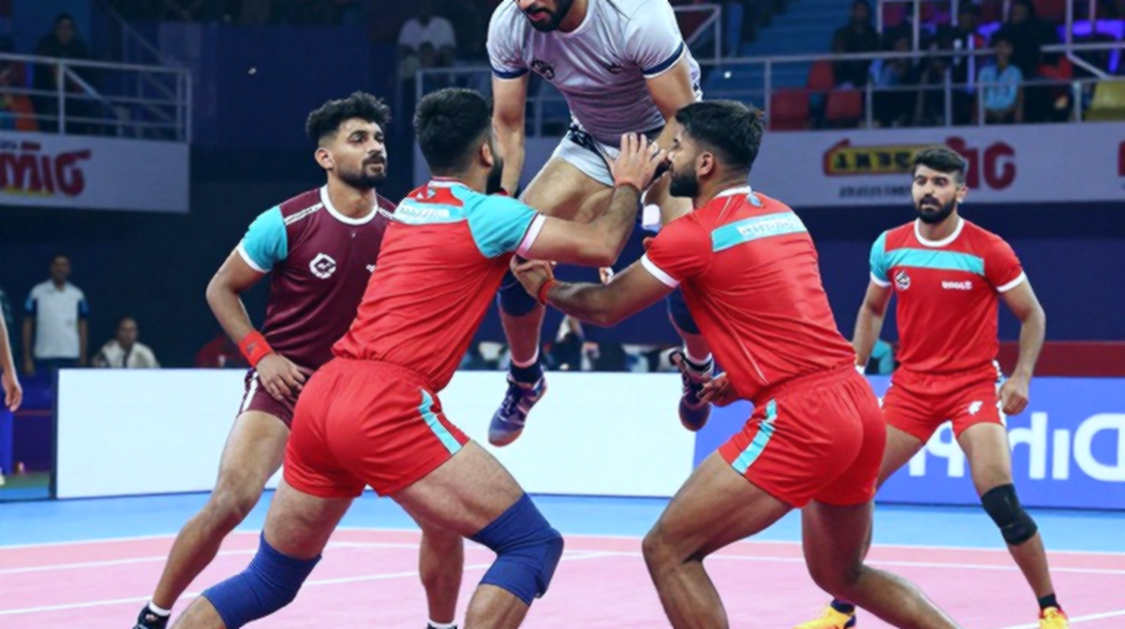
The chain has a trap in it. Do-or-die makes the third raid compulsory scoring, and if your lead raider is a bonus specialist — a man whose largest income stream depends on a strong defence being on the mat — the rule pushes him into exactly the moment when the defence has thinned and the bonus line stops paying. The rulebook has disabled the raider's most reliable weapon at his most necessary moment. That is the technical meaning of a deputy captaincy: the man has to still be on the mat when the rules take his hands away.
Which raises the question nobody asked. If the deputy is a raider, the captain is not one, which means India's raiding unit is being built on depth rather than reputation this cycle. That is a defensible call. It is also a statement, and testing it needs four numbers the announcement does not carry: raid-success rate of the raiding corps, tackle efficiency of the defensive unit, do-or-die conversion, and average points conceded per all out. Without one of those four, ranking captaincies is like pricing a player at auction and never asking what he produced. Every captaincy has a price. I price the gap between price and output, and this release provides no way to compute either.
The missing head coach is a separate omission, and a technical one rather than a political one. If captain and coach disagree on a do-or-die raider, who holds the final veto? In league play, reviews and substitutions sit with the coach; in national setups captains often get more latitude. Until the coach is named, the decision chain cannot be mapped, and without the map you cannot say whether a failure belonged to the armband or to the meeting room.
September 2026 comes back here, and not comfortably. I watched the Jakarta semi-final at four in the morning, India 18, Iran 27. That night I did not write three thousand words on India losing; I wrote them on Iran's wrestling-derived ankle holds showing up in tackle data seasons before anyone covered it, with Fazel Atrachali's tackle numbers as the spine. The lesson was structural: before a major tournament, the opponent's file gets built first and your own team's second. Eight years later, this announcement does not name a single opponent. We are not entering 2026 with more information than 2026. We are entering with less, and the decline belongs to information management, not to players.
Fitness is the other thing absent that should not be. Injury disclosure in kabaddi surfaces only when it suits a franchise or a federation, which is to say almost never. Without a squad list we do not even know whether the deputy will take the mat. Announcing a captaincy while withholding a fitness status is the cleanest available illustration of which information is permitted to be public and which is not.
Now read it backwards, because reading it forwards carries no risk.
The safe-looking choice is the actual risk. A defender-captain's instinct — not a flaw, a product of the job — is conservative: hold the line, do not err, do not concede points. The do-or-die rule punishes precisely that instinct, because on the third raid caution costs more than risk. The man who must decide who raids has spent a career learning to keep risk low. The contradiction does not show in the announcement. It will show on the mat, when there is no time left to fix it.
The second counter-argument shrinks the whole debate. Who wears the armband matters less than which rulebook and which sanction govern the event. If Circle Style players take the mat, corner calling, bonus-line arithmetic and the do-or-die clock all become decoration. We are grading the captaincy of a team with an unknown squad, unknown opponents and an unknown rule set. When I doubt my own method, I do this: I state in advance what would prove me wrong.
On the record, before a single raid: if more than a third of India's do-or-die raids in this tournament go scoreless, my discipline-plus-firepower reading was wrong, because the split did not function — it only looked tidy on paper. And if the tournament is played under Circle Style or a hybrid rule set, treat my entire technical frame as void, because the right question then is not who captains India but why India did not build a separate side for the format. I keep models falsifiable, because a model that cannot fail is not a model. It is advertising.
Three things I will watch in this tournament, none of which will appear on the scoreboard. The third raid of the fifth minute, and who takes it. When the first television review is called, since an early review says the captain is reading the match and a late one says he is reacting to it. And whether the squad and fitness picture is published before the tournament or after it.
The day this championship's rulebook and sanction are published, the team actually begins. Until then Surjeet Singh's captaincy is a position, not a fact — and the columns I would need to grade it are still empty.